
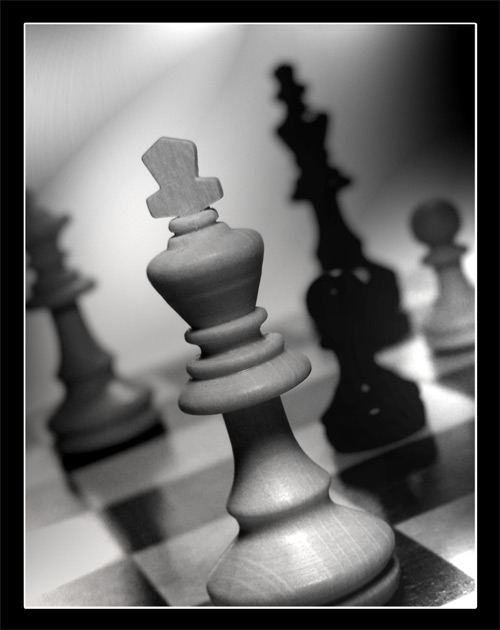
King is a most important piece on the table.
The game
Chess is a two-player strategy board game played on a checkered board with 64 squares arranged in an 8×8 grid.[1] The game is played by millions of people worldwide. Chess is believed to be derived from the Indian game chaturanga sometime before the 7th century. Chaturanga is also the likely ancestor of the Eastern strategy games xiangqi, janggi, and shogi. Chess reached Europe by the 9th century, due to the Umayyad conquest of Hispania. The pieces assumed their current powers in Spain in the late 15th century; the modern rules were standardized in the 19th century.
Play involves no hidden information. Each player begins with 16 pieces: one king, one queen, two rooks, two knights, two bishops, and eight pawns. Each piece type moves differently, with the most powerful being the queen and the least powerful the pawn. The objective is to checkmate[note 1] the opponent’s king by placing it under an inescapable threat of capture. To this end, a player’s pieces are used to attack and capture the opponent’s pieces, while supporting each other. During the game, play typically involves exchanging pieces for the opponent’s similar pieces, and finding and engineering opportunities to trade advantageously or to get a better position. In addition to checkmate, a player wins the game if the opponent resigns, or (in a timed game) runs out of time. There are also several ways that a game can end in a draw.
The first generally recognized World Chess Champion, Wilhelm Steinitz, claimed his title in 1886. Since 1948, the World Championship has been regulated by the Fédération Internationale des Échecs (FIDE), the game’s international governing body. FIDE also awards life-time master titles to skilled players, the highest of which is Grandmaster (GM). Many national chess organizations have a title system of their own. FIDE also organizes the Women’s World Championship, the World Junior Championship, the World Senior Championship, the Blitz and Rapid World Championships, and the Chess Olympiad, a popular competition among international teams. FIDE is a member of the International Olympic Committee, which can be considered as a recognition of chess as a sport.[2] Several national sporting bodies (e.g. the Spanish Consejo Superior de Deportes[3]) also recognize chess as a sport. Chess was included in the 2006 and 2010 Asian Games. There is also a Correspondence Chess World Championship and a World Computer Chess Championship. Online chess has opened amateur and professional competition to a wide and varied group of players.
Since the second half of the 20th century, chess engines have been programmed to play with increasing success, to the point where the strongest programs play at a higher level than the best human players. Since the 1990s, computer analysis has contributed significantly to chess theory, particularly in the endgame. The IBM computer Deep Blue was the first machine to overcome a reigning World Chess Champion in a match when it defeated Garry Kasparov in 1997. The rise of strong chess engines runnable on hand-held devices has led to increasing concerns about cheating during tournaments.
There are many variants of chess that utilize different rules, pieces, or boards. One of these, Chess960, has gained widespread popularity as well as some FIDE recognition.
Pieces and Movement
In competitive games, the colors are allocated by the organizers; in informal games, the colors are usually decided randomly, for example by coin toss, or by one player’s concealing a white and black pawn in either hand and having the opponent choose. The player with the white pieces moves first, after which players alternate turns, moving one piece per turn (except for castling, when two pieces are moved). A piece is moved to either an unoccupied square or one occupied by an opponent’s piece, which is captured and removed from play. With the sole exception of en passant, all pieces capture by moving to the square that the opponent’s piece occupies.
Moving is compulsory; it is illegal to skip a turn, even when having to move is detrimental. A player may not make any move that would put or leave the player’s own king in check. If the player to move has no legal move, the game is over; the result is either checkmate (a loss for the player with no legal move) if the king is in check, or stalemate (a draw) if the king is not.
Each piece has its own way of moving. In the diagrams, the dots mark the squares to which the piece can move if there are no intervening piece(s) of either color (except the knight, which leaps over any intervening pieces).
- The king moves one square in any direction. The king also has a special move called castling that involves also moving a rook.
- A rook can move any number of squares along a rank or file, but cannot leap over other pieces. Along with the king, a rook is involved during the king’s castling move.
- A bishop can move any number of squares diagonally, but cannot leap over other pieces.
- The queen combines the power of a rook and bishop and can move any number of squares along a rank, file, or diagonal, but cannot leap over other pieces.
- A knight moves to any of the closest squares that are not on the same rank, file, or diagonal. (Thus the move forms an “L”-shape: two squares vertically and one square horizontally, or two squares horizontally and one square vertically.) The knight is the only piece that can leap over other pieces.
- A pawn can move forward to the unoccupied square immediately in front of it on the same file, or on its first move it can advance two squares along the same file, provided both squares are unoccupied (black dots in the diagram); or the pawn can capture an opponent’s piece on a square diagonally in front of it on an adjacent file, by moving to that square (black “x”s). A pawn has two special moves: the en passant capture and promotion.
Castling
Once in every game, each king can make a special move, known as castling. Castling consists of moving the king two squares along the first rank toward a rook (that is on the player’s first rank and then placing the rook on the last square that the king just crossed. Castling is permissible if the following conditions are met:[5]
- Neither the king nor the rook have previously moved during the game.
- There are no pieces between the king and the rook.
- The king cannot be in check, nor can the king pass through any square that is under attack by an enemy piece, or move to a square that would result in check. (Note that castling is permitted if the rook is under attack, or if the rook crosses an attacked square.)
Check
When a king is under immediate attack by one or two of the opponent’s pieces, it is said to be in check. A move in response to a check is legal only if it results in a position where the king is no longer in check. This can involve capturing the checking piece; interposing a piece between the checking piece and the king (which is possible only if the attacking piece is a queen, rook, or bishop and there is a square between it and the king); or moving the king to a square where it is not under attack. Castling is not a permissible response to a check.
The object of the game is to checkmate the opponent; this occurs when the opponent’s king is in check, and there is no legal way to remove it from attack. It is never legal for a player to make a move that puts or leaves the player’s own king in check. In casual games it is common to announce “check” when putting the opponent’s king in check, but this is not required by the rules of chess, and is not usually done in tournaments.
Win
Games can be won in the following ways:
- Checkmate: The player whose turn it is to move is in check and has no legal move to escape check.
- Resignation: Either player may resign, conceding the game to the opponent.[6] It is usually considered poor etiquette to play on in a hopeless position, and for this reason high-level games rarely end in checkmate.
- Win on time: In games with a time control, a player wins if the opponent runs out of time, even if the opponent has a superior position, as long as the player has a theoretical possibility to checkmate the opponent.
- Forfeit: A player who cheats, violates the rules, or violates the rules specified for the particular tournament, can be forfeited. In high-level tournaments, players have been forfeited for such things as:
- arriving late for the game (even by a matter of seconds);
- receiving a call or text on a cell phone;
- refusing to undergo a drug test;
- refusing to undergo a body search for electronic devices;
- unsporting behavior (e.g. refusing to shake hands with the opponent).
 My blog